02Building a data validation tool for image recognition
Context
Neurolabs
Year
2023 — 2026
Role
Product designer
Practice
User research · Workflow design · Data-heavy UI · Coded prototyping · Designing for ML tools · Working with engineers
TL;DR
The data validation tool started as a viewer built by engineers. I redesigned it twice. The first time, users could finally correct predictions and turn them into training data. The second time came after two years of organic growth pushed it past its limits.
Problem
Neurolabs uses computer vision to recognise products on supermarket shelves for consumer goods brands. Our model finds each product on a shelf photo, then compares it with the products in our catalogue to work out which one it is. Each product has reference images, crops of that product from real shelves, and the more good ones it has, the better the model recognises it.
2023
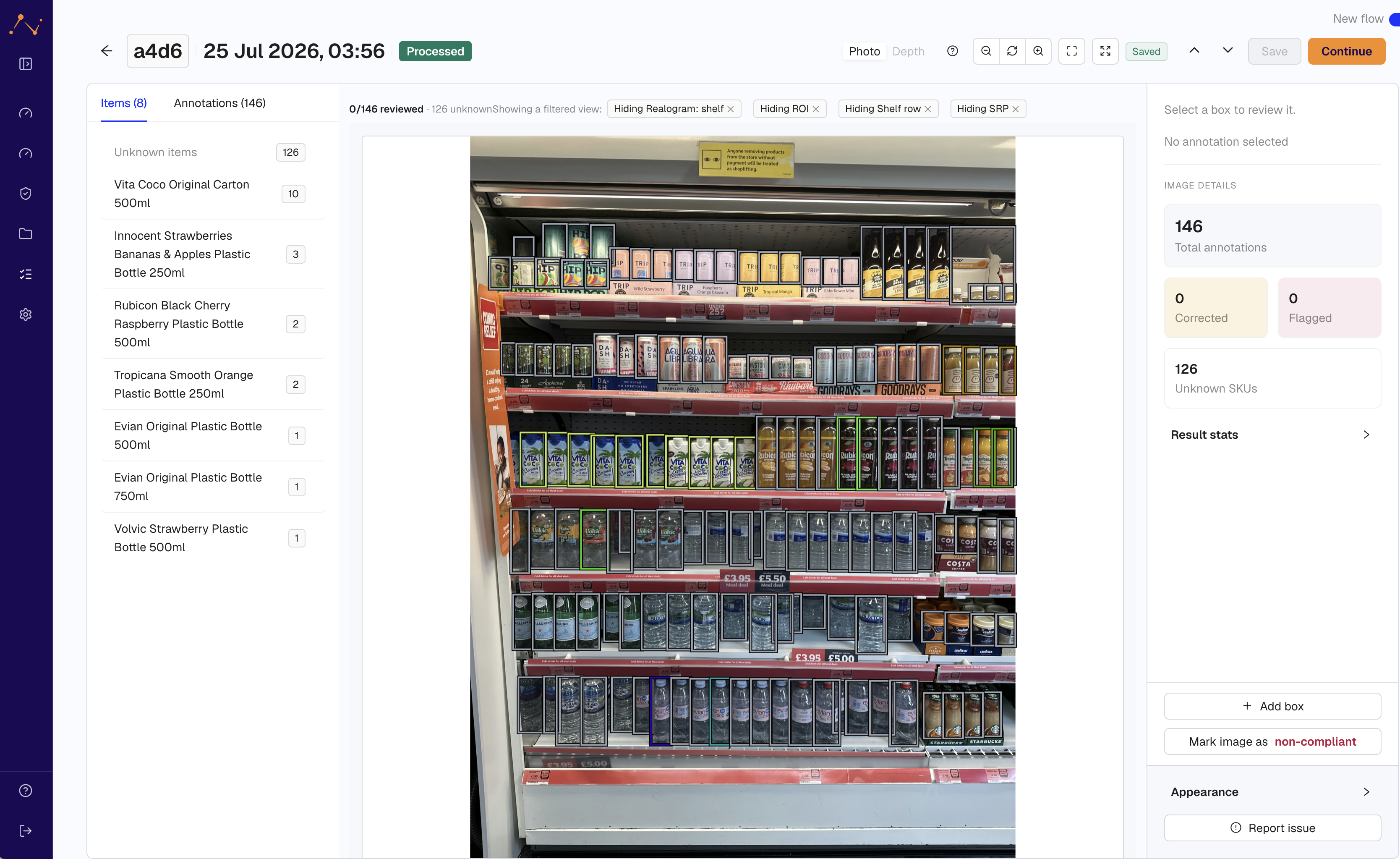
When we formed the product team in 2023, the web app could show a shelf image with its bounding boxes, but you couldn’t do anything with what you saw.
To improve the model, someone from our team was taking screenshots of wrongly detected products, or running a script to extract them, and adding the crops to our catalogue by hand. Clients were also asking what our accuracy was, and we had no way to measure it on real data.
2025
Two years later, the tool hit a different limit. Our models could now detect prices, quantities, posters and more, but the tool was built only for products. Every new data type meant changing code. That was slow and error prone, and we couldn’t validate those data types the same way.
Outcome
v1
The first version gave us our first loop of improving the catalogue and measuring accuracy.
In less than 5 minutes we could correct a whole image and add the fixed crops to the catalogue with one button.
It became the most used tool in the web app. We hired contractors to use it full time, computing and improving accuracy for multiple clients as we started offering this as a service. Validations now run every two weeks or monthly, and the accuracy figures go to clients regularly so they can trust the model.
2.0
For Validation 2.0, I used AI to build a prototype connected to our real APIs, and tested it with internal users, contractors and clients before the real build. Our front end engineer implemented it much faster and closer to my designs. It became the default for everyone in September 2026.
Full case study in progress. Happy to walk you through it in the meantime: camilogiraldo31@gmail.com