February 2026
My way of working
I'm driven mostly by learning new things and finding connections between different fields. I experiment with different techniques and mediums, and go on deep dives into the history of a craft and how it evolved. If I see something I want to try, I just do it: I buy the materials, download the software, watch YouTube videos, read about it and then try things out. I make mistakes and experiment with ideas. My notes app is full of pages called idea, some simple, some crazy. All of this has given me a wide range of knowledge across technology, design and craft that I draw on in everything I do.
Rabbit holes
When I visit a new city, I look at the signs, the typefaces, the doors and their handles, and wonder where they came from. In Prague recently, that led me to read about the early 1900s Art Nouveau movement there, the last years of the Austro-Hungarian empire and the influence of the Vienna Secession. I went through the local museums' websites, which have lots of free resources and access to their collections. I also wanted to understand what life was like at the time, so I started reading Stefan Zweig's The World of Yesterday.
I write about these rabbit holes in El Reblujo ↗
Between analogue and digital
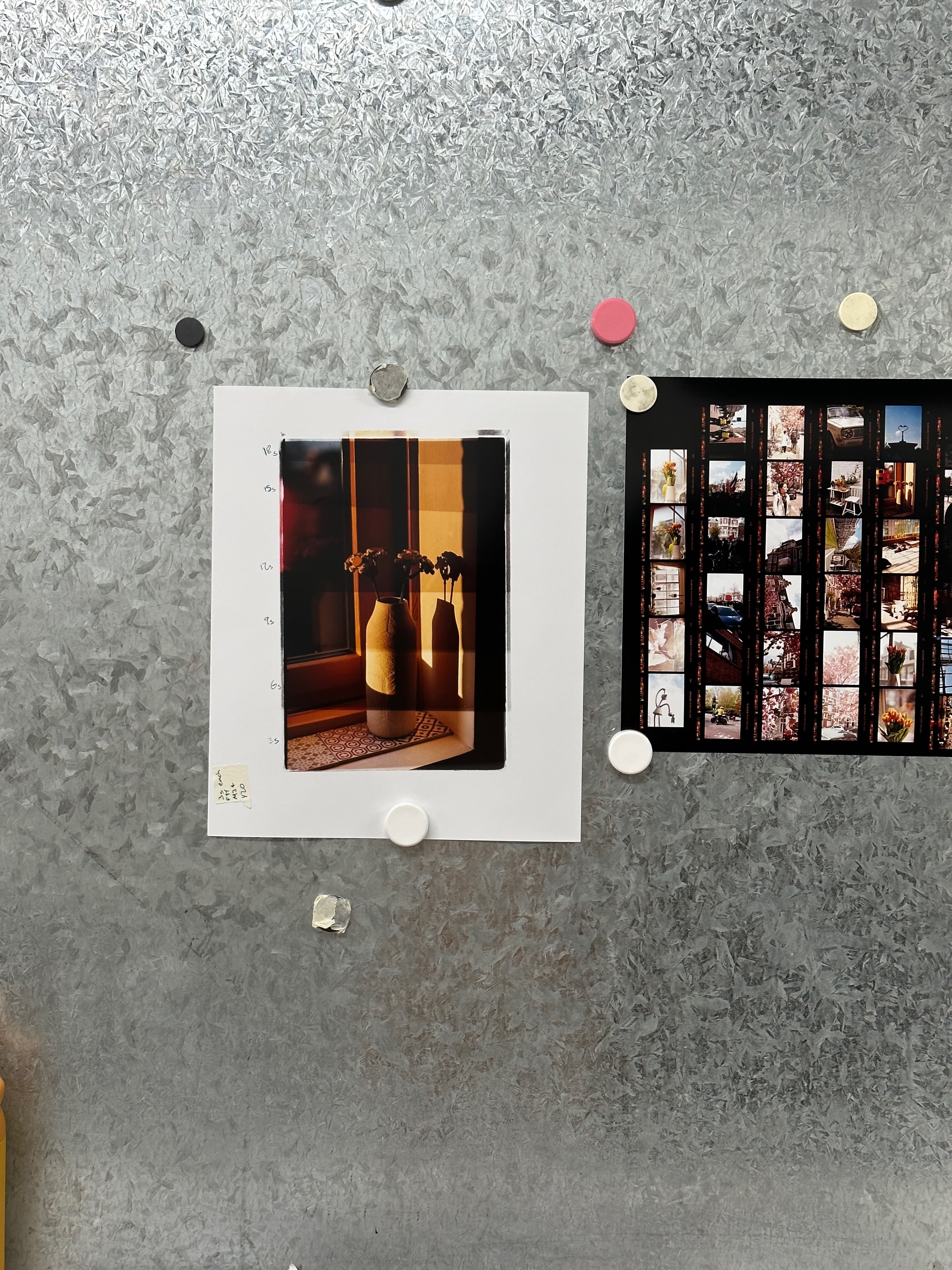
I'm always working where analogue and digital meet. I make clothes by sewing, knitting and crocheting, and I've also made them in 3D, modelling sewing patterns and simulating them for animation. Learning screen printing taught me how light and shadow are built from dots, which led me to risograph, and then to doing the same thing digitally: turning colour pixels into greyscale, and greyscale into dots.
Where I come from
I studied product design engineering. I've designed patient-specific implants for 3D printing from CT scans, working with surgeons and the constraints of the human body. I've prototyped and built cattle feeders. And I co-founded a 3D design studio with a friend, where I spent three years as creative director and 3D generalist, taking clients' projects in fashion, product and events from idea to execution.
While running the studio, I joined a computer vision company in London as a 3D technical artist, building procedural pipelines in Houdini that generated synthetic data to train machine learning models. I then became its first and only product designer. I drove a redesign of the product around its users, pushing us to question who we were serving and what they needed. I designed an iOS app from 0 to 1 and kept evolving it as the product changed. I'm involved in every part of the process, from framing the problem and talking to users, to working through constraints with engineers, prototyping, sometimes implementing features in the product, and QA.
A builder first
I don't see my role as product designer, user researcher or front-end developer, but as a builder who wants to deliver something and finds the tools to make it happen. I don't see what I don't know yet as a limit, but as a chance to experiment, learn and grow. I'm not afraid to have my assumptions challenged, to change how I work or to learn new tools.
Since 2019 I've gone from designing medical implants in Brazil to prototyping cattle equipment in Colombia, running a 3D studio, building procedural ML pipelines and leading product design at a computer vision startup in London, and I've never stopped making things on the side.
— Camilo